Start here
What is Wheelhouse
Every piece of agent work as a docket, on a record you can check. What Wheelhouse is, who it's for, and the ideas it rests on.
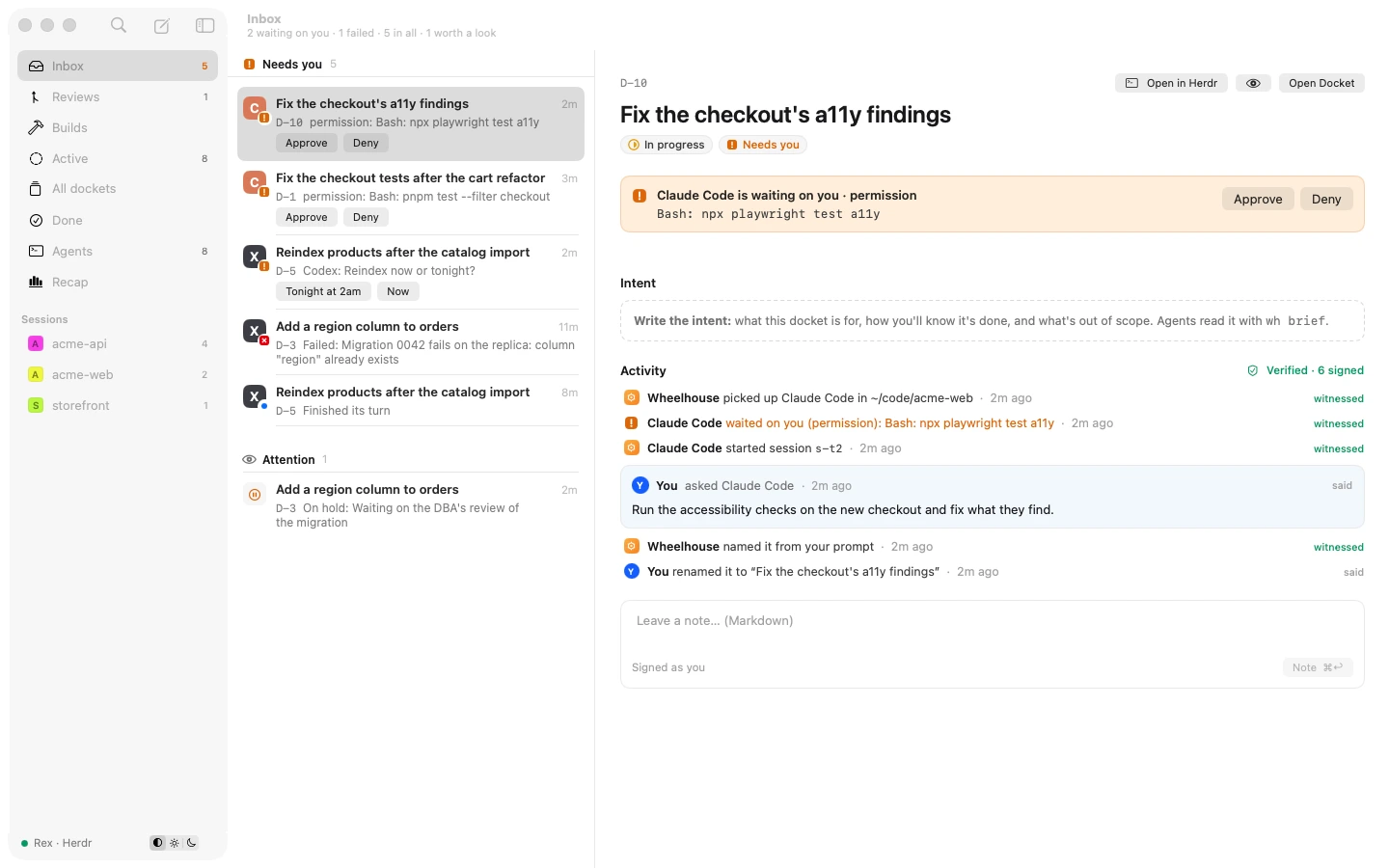
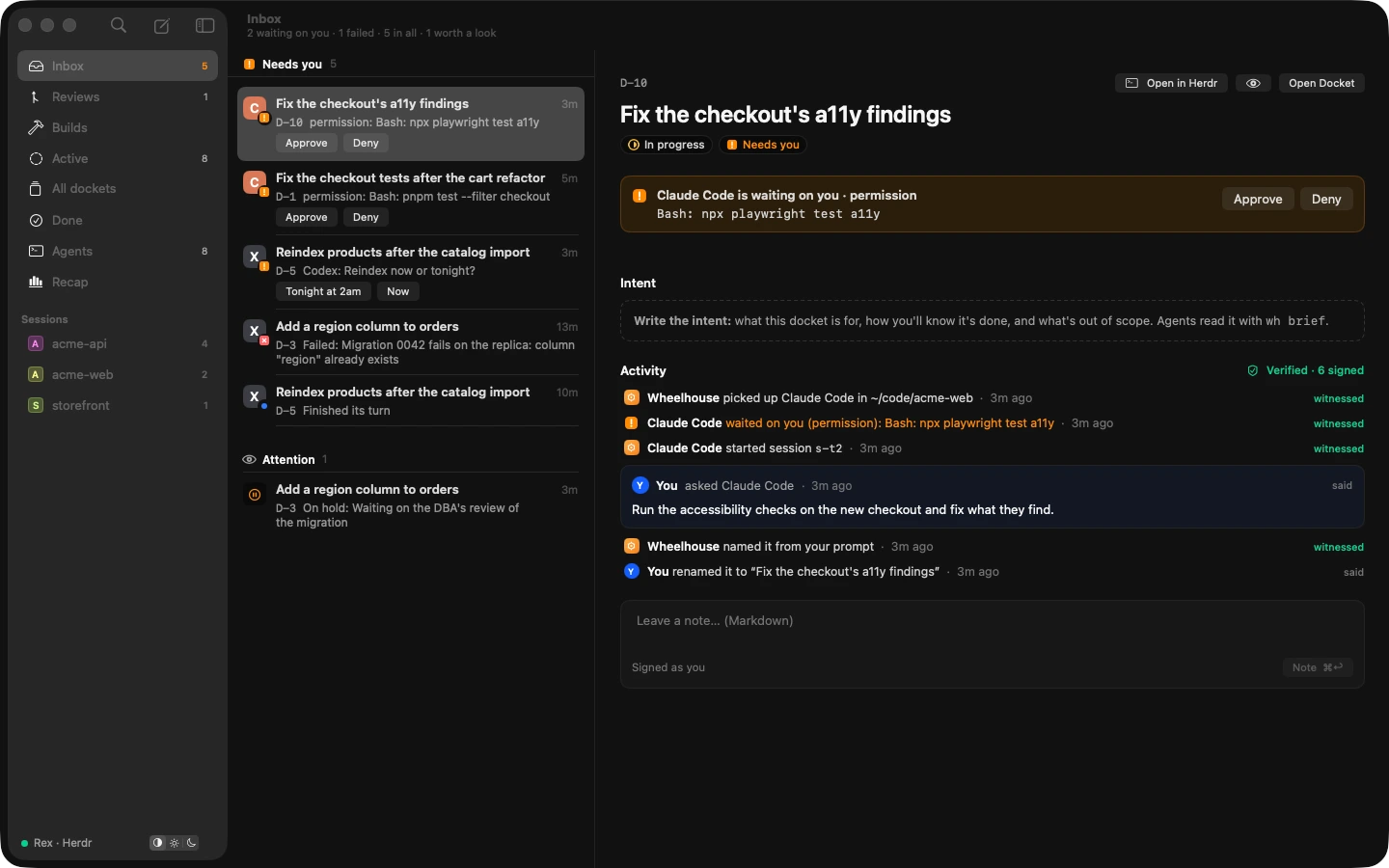
Wheelhouse is where you run all your agent work on your Mac. Each piece of work is a docket. Your agents (Claude Code, Codex, Antigravity or Pi) run in Rex or Herdr, side by side. Wheelhouse follows them, briefs them and watches them. It asks you only what you must decide, and keeps a record you can check.
Who it’s for
Section titled “Who it’s for”One developer running many agents in Rex or Herdr, across their own Macs. Your work is in GitHub repos, with issues in Linear or GitHub. You review other people’s PRs and write your own, and you start agents by hand all day. You want to steer all of it from one place, on the Mac or on your phone, without watching panes.
With Teams, several of those developers share the dockets they choose, and their agents work together across Macs.
What you get
Section titled “What you get”- A docket for every agent. Every agent in a Rex pane or a Herdr terminal gets one: when it worked and when it waited on you, the files it made, and how it ended. For Claude Code, Antigravity and Pi, also what you asked and what the agent answered.
- One Inbox. Permission prompts, questions with answers as buttons, failures, finished turns and reviews ready to post, from every agent, on the Mac, in the menu bar, in a notification or on your phone.
- Chat from anywhere. Talk to any agent from your phone. What you send while it works is queued and goes in when its turn ends.
- Steer a docket from one box. Under its Activity: a note,
@testsor@allto instruct its agents,/askto ask them,/decideto record a decision they’ll all work from,/taskto add another agent. - Review and Build. PRs that request you get a multi-agent review you approve before it posts. A docket’s intent becomes a PR you approve before it opens, and review rounds become fixes you approve before they push.
- Checks the hub runs itself. Done rests on evidence: your repo’s checks, run by the hub at the commit, recorded as witnessed.
- Recap. What happened today, this week or in 30 days, as a standup note, and the tokens it took and what they cost.
The ideas it rests on
Section titled “The ideas it rests on”- One record. Every piece of work is a docket, and everything that happens to it is an entry. Every screen is a view of the record.
- Agents do, you decide. Agents ask only what only you can decide. A question comes with options and a recommendation, and the agent keeps working on the recommendation while it waits.
- Nothing goes outward without you. Review’s and Build’s agents don’t push, post, or open a PR. Wheelhouse does those things for them after you approve, or under a standing order your config sets. Nothing ever merges. (An agent you start by hand in your own pane runs as you, with your logins: see Security.)
- Every claim says how it’s known. An entry is said, witnessed or checkable. A docket with acceptance boxes closes on evidence, not on what was said, unless you close it on your word, with a reason, on the record.
- The runtime holds the panes. Panes live in Rex or Herdr. Wheelhouse never draws a terminal: Open takes you to the pane.
- Answer from anywhere. The window, the menu bar, a notification, the phone, the keyboard, or a terminal.
- Quiet by default. It notifies only for what needs you, and only once.
The words it uses
Section titled “The words it uses”| Word | What it means |
|---|---|
| Docket | One piece of work, from the first ask to the last merge, numbered D-41. It has a title, a status, an intent, and the issue or PR it came from. |
| Intent | A docket’s living spec: what must be true when it’s done, its acceptance boxes, and what’s out of scope. |
| Entry | One signed, append-only record in a docket’s log. A correction is a new entry that names the one it replaces. |
| Protocol | The playbook a docket follows: Agent (one you started by hand), Review or Build. |
| Ask | Something that waits on you: a permission prompt, a question, a gate, a failure, a message. Your Inbox is your open asks. |
| Standing order | A rule your config sets, shown as a sentence in Settings: when something happens, do something. “When a PR in acme/api requests me, Review it.” |
| Runtime | The terminal multiplexer an agent’s pane is in: Rex or Herdr. |
| Hub | wh serve: the process on your Mac that follows the runtimes, keeps the record and serves the apps. |
How it fits together
Section titled “How it fits together”The hub runs at login on your Mac. It follows Rex’s and Herdr’s events, mirrors their sessions and panes, and gives each agent a docket. Claude Code’s and Antigravity’s hooks, and Pi’s extension, add your prompts and their turns.
The record is a local SQLite database: one signed, chained entry per thing that happened. Keys are Ed25519, one per signer, on your Mac.
The apps are Wheelhouse.app on the Mac and the same app in a browser at
http://127.0.0.1:7500, or on your phone over Tailscale. Agents use the wh
CLI from their panes to read their brief, message you and each other, and keep
files on their docket.