Concepts
The record
Each docket is a log of signed, chained entries. What's on it, how each entry is known, and what wh verify proves.
A docket is its entries, in order. An entry is never changed or removed: a correction is a new entry that names the one it replaces. Everything else you see on a docket (its title, status, agents, what it waits on) is worked out from the entries, and can be rebuilt from them at any time.
What’s on it
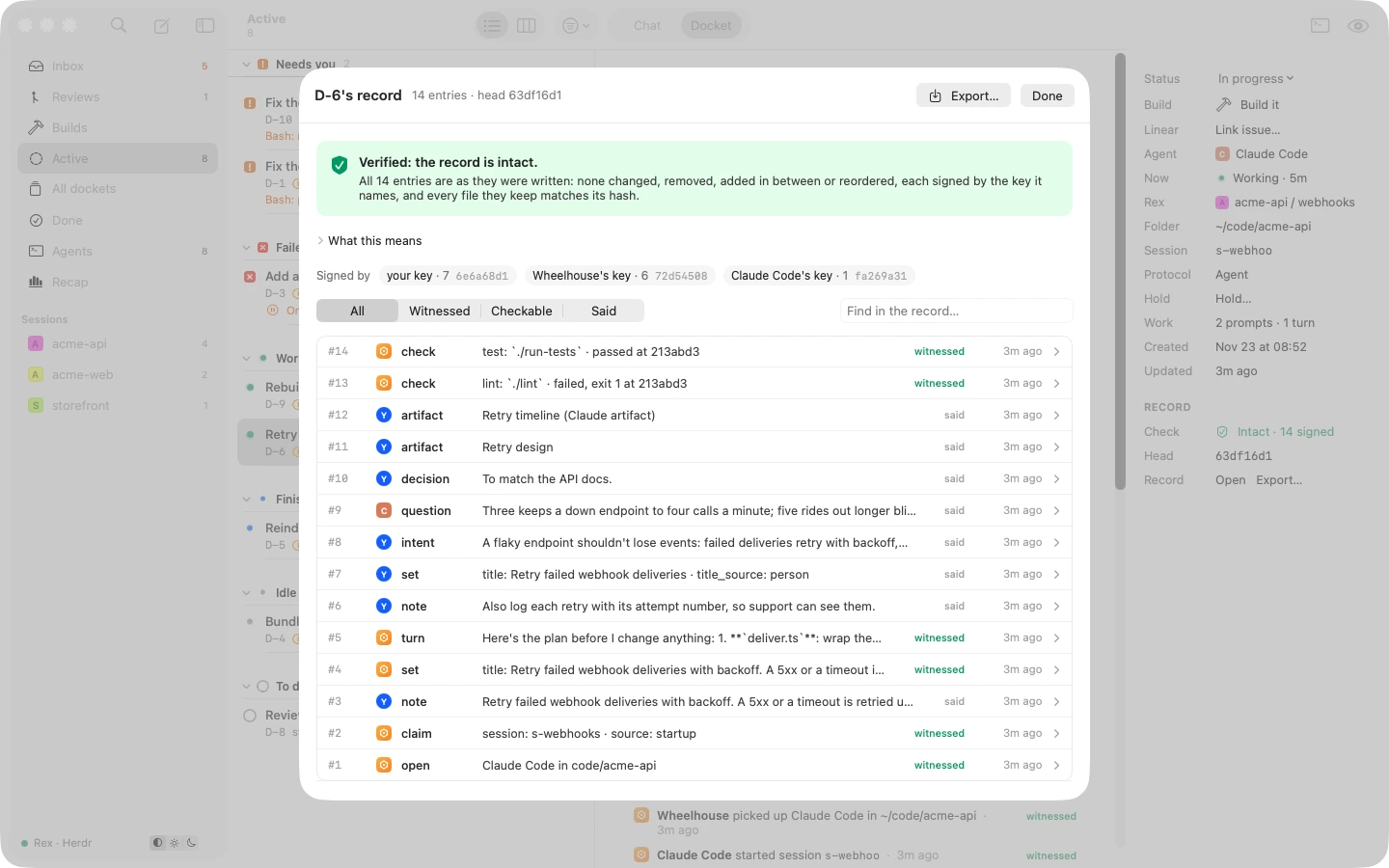
Section titled “What’s on it”One entry per thing that happened: an agent opening, a prompt you gave it, the end of each turn with its last message, a note, a question and its answer, an approval, a status change, a check the hub ran, a checker’s verdict, a file the work kept. Each entry names who wrote it:
- You, for what you say: notes, titles, prompts you give an agent, approvals.
- The hub, for what it saw: an agent opening, a turn ending, a pane closing, a check it ran.
- An agent, for what it says through
wh: notes, messages, files it keeps.
How each entry is known
Section titled “How each entry is known”Every entry carries a mark, worked out from who wrote it and what it is:
| Mark | When |
|---|---|
| witnessed | The hub wrote it: it saw this happen. A turn ending, a check’s exit code at a commit. |
| checkable | A link or an observation read from a source anyone can read again: a Linear issue, a PR, a review on GitHub. |
| said | A person or an agent wrote it. True if you trust them. |
That’s why a docket with acceptance boxes can’t close on an agent saying “tests pass”: that’s said. A check the hub ran itself is witnessed. See Verify.
Signed and chained
Section titled “Signed and chained”- Signed. Each entry is signed with Ed25519 by the key of whoever wrote it, in a DSSE envelope. The keys live on your Mac: one for you, one for the hub, and one per agent app.
- Chained. The hub gives each entry the next number on its docket, with no
gaps, and chains each entry’s hash to the one before it. The last link is the
docket’s head. Its first eight characters name the docket’s exact state,
as in a PR footer:
Docket: D-12 @ 9f2c41ab. - Files by hash. A file an entry names is kept once, by the sha256 of its bytes, and the signature covers that hash. A changed file no longer matches, and a lost one is missing.
Checking a record
Section titled “Checking a record”wh verify D-12 # one docket, every kept file includedwh verify # every docketOr click Verified on any docket to read its record: who signed each entry, how each is known, and what the check means (and doesn’t).
A passing check means that since each entry was written, nothing in it has changed, nothing was removed, added in between or reordered, each was signed by the key it names, and each file is as it was.
Exporting a record
Section titled “Exporting a record”A docket’s record exports as JSON lines that check without the hub, with only the public keys they name:
wh export D-12 > D-12.jsonlwh verify --file D-12.jsonlEach line carries an entry’s number, its id, its chain value, and its envelope’s exact bytes. Anyone with the file can check that it’s intact.
On a team
Section titled “On a team”A docket you share with your team keeps the same format. Every entry is signed by whoever wrote it, on their own Mac, and the workspace hub only orders them. Every member’s hub keeps a copy and checks it entry by entry, so a workspace hub that changes, drops or reorders an entry is caught.