Protocols
Review
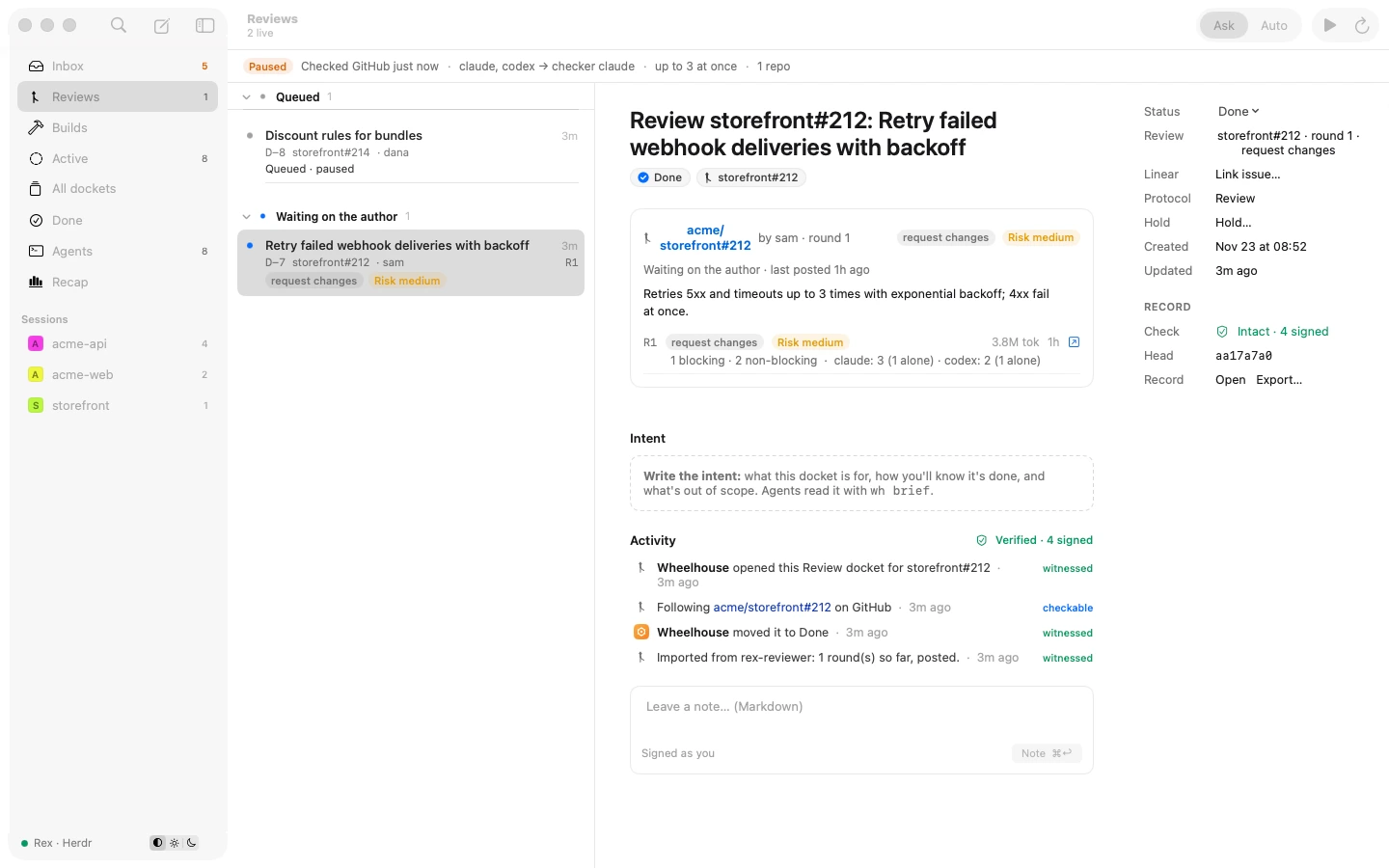
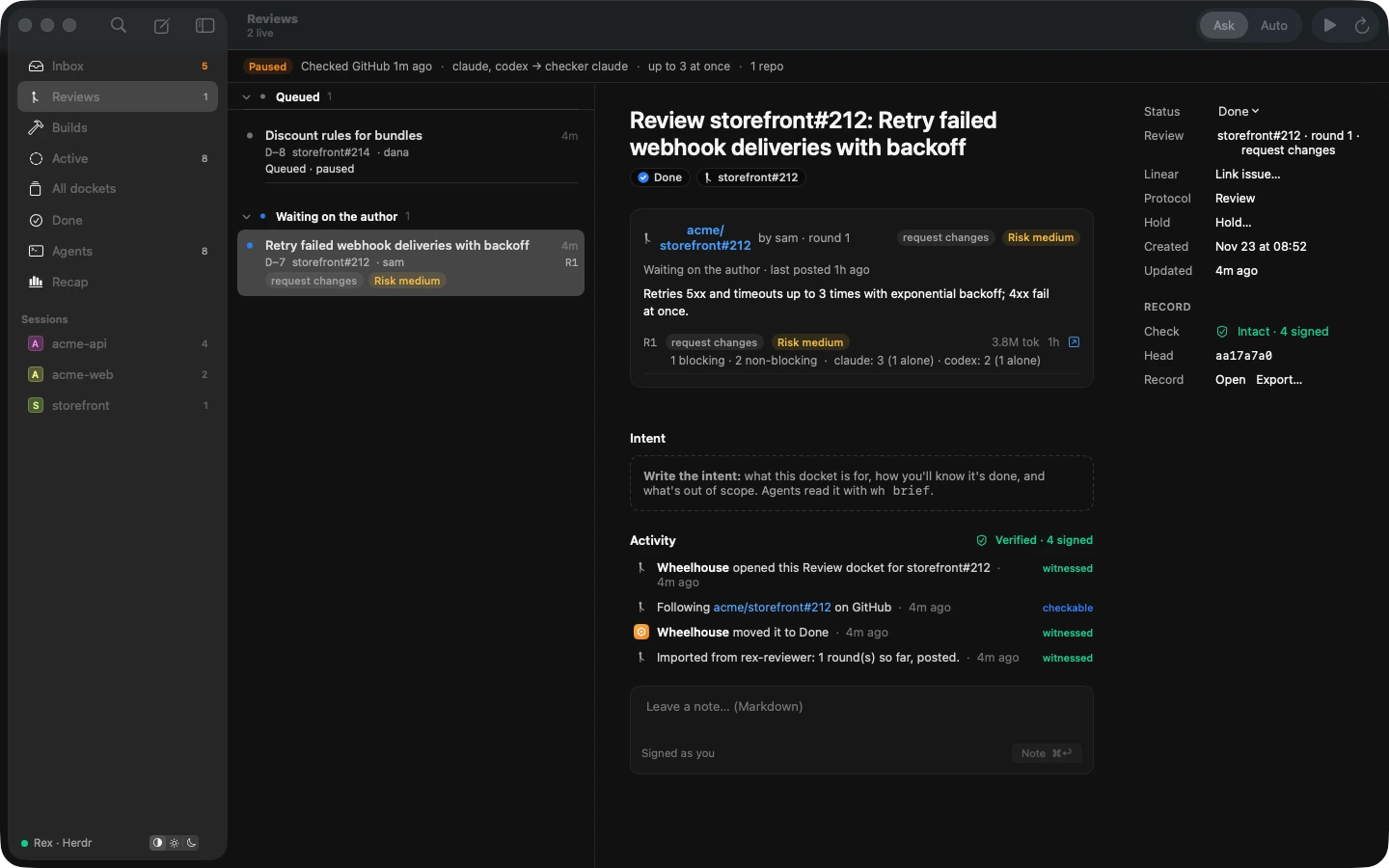
A PR that requests you becomes a Review docket. Blind reviewers, a checker that merges their findings and rates the merge risk, and a review that posts only when you say so.
A PR that requests you by name, in a repo your review config lists, becomes one Review docket for its whole life. Agents review it in Rex or Herdr, a checker checks their findings, and you decide what gets posted. The review posts from your GitHub account.
Set it up
Section titled “Set it up”Review is off until you set it up. With the hub running:
-
Install LuaJIT (
brew install luajit). The config is a Lua file. -
Sign in to GitHub with
gh auth login. Reviews post from your account. -
From your clone of Wheelhouse, copy the example config to
~/.config/wheelhouse/review.lua, and list your repos with the path to your clone of each:Terminal window mkdir -p ~/.config/wheelhousecp examples/review.lua ~/.config/wheelhouse/review.lua -
Turn Review on. It starts paused, so nothing runs until you resume it:
Terminal window wh review on # checks the config; starts pausedwh review # the config it read, and the PRs it seeswh review resume # rounds start
A small config:
return {  repos = {    ["acme/api"] = {      checkout = "~/code/acme-api",      notes = [[Run `just test` for the unit tests and `just lint` before a finding about style.Migrations live in db/migrations/ and must be reversible.]],    },  },
  -- One to four reviewers, each blind to the others. The first is the primary.  reviewers = { "claude", { name = "codex", agent = "codex" } },  checker = "claude",
  -- Who posts a checked review: "ask" (you), "auto" (the checker), or a rule.  post = "ask",
  poll_seconds = 180,  max_rounds = 3,}
The full example, with every key commented, is
examples/review.lua.
The hub reads the file again whenever it changes, and wh review says what’s
wrong with it, if anything. Settings in the apps changes the parts that
aren’t code (posting, agents, notes) without editing the file; see
Settings.
How a round goes
Section titled “How a round goes”-
Prep. The hub fetches the PR’s head and base with your
ghlogin, puts each reviewer in a worktree of its own at that head, and gathers the round’s context: the PR, its diff, its reviews, comments, threads and CI. Your own working copy isn’t touched. -
Reviewers. One to four agents, each blind to the others, each in its own pane of the
wheelhouse-reviewssession (a tab per PR, in Rex or Herdr).ghis signed out in their panes. Each writes a draft review and a report. -
Checker. A fresh agent merges the drafts, checks every finding, notes which reviewers found each one, and rates the merge risk: low, medium or high.
-
Post. With
post = "ask", the round waits for you: Post, Preview or Dismiss, in the Inbox, on Reviews, on the docket, or in a notification. Or from the terminal withwh review postandwh review dismiss. -
Later rounds. A re-request starts the next round. The same reviewers resume with what changed since the last one. A push mid-round sends them the new commits in the same round.
-
End. When the PR merges or closes, the panes close, and the worktrees and refs are removed.
Everything that happens goes on the docket’s record, and each round’s reports, checked review and merge risk are kept as files on it.
What the PR is for
Section titled “What the PR is for”When a review starts, the hub reads which Linear issues the PR addresses:
Linear’s own link on the PR, closing words like Closes ENG-12, other magic
words like Part of ENG-12, the branch name, and the title. A bare mention in
the description doesn’t count. Each issue is linked on the docket.
From these it writes the docket’s intent: the PR, its author, the issues it addresses, the author’s own summary, and what the review holds it to: its part of each issue’s acceptance criteria. The intent follows the PR while it’s Wheelhouse’s; once you edit it, it’s yours.
Who posts
Section titled “Who posts”post says who posts a checked review, for every repo. A repo’s own post
wins for that repo.
"ask": it waits for you."auto": the checker posts it.{ auto = { … } }: a rule. It posts itself only when every condition holds. Otherwise it waits for you, and the Inbox says why (“merge risk is medium (auto needs low)”).- A function of the PR and its checked review, returning
"ask"or"auto".
post = { auto = { verdict = "approve", merge_risk = "low", max_lines = 300 } },repos = { ["acme/api"] = { checkout = "~/code/acme-api", post = "ask" }, ["acme/docs"] = { checkout = "~/code/acme-docs", post = "auto" },},| Condition | Holds when |
|---|---|
verdict = "approve" |
The review approves. One that requests changes asks. |
merge_risk = "low" or "medium" |
The merge risk is that or lower. |
max_lines = N |
The PR changes at most N lines. |
authors = { … } |
The PR is by one of them. |
labels = { … } |
The PR has one of these labels. |
not_touching = { … } |
No changed path contains any of them. |
wh review post-mode ask or auto puts every repo on ask or auto until
wh review post-mode config. Standing orders in Settings say in a sentence what
posting does now.
What never posts
Section titled “What never posts”Whoever posts, a review is refused when:
- its event isn’t approve or request changes, or doesn’t match its blocking findings;
- it has no verdict, or a finding has no title;
- the merge risk is missing (with the merge-risk guide on) or isn’t one of the rubric’s words;
- any of its prose speaks in the first person, outside code;
- the PR isn’t open, or its head moved past the round’s. The hub then follows the new head on its own.
Only you, the PR’s own checker in auto mode, or the hub when your rule holds,
can post. Only you can dismiss.
Effort and guides
Section titled “Effort and guides”Effort is low, medium, high, xhigh or max, or nil for the agent’s
own setting. A reviewer’s own effort wins, then the repo’s, then the top-level
one. It can be a function of the PR, so a migration gets more thought than a
typo fix:
effort = { review = function(pr) if pr.touches({ "db/migrations/", "auth/" }) then return "xhigh" end return pr.lines < 150 and "medium" or "high" end, check = "medium",},Guides go into the briefs: what to look for (review), how the posted
review reads (style), the merge-risk rubric (merge_risk), and more for the
checker (check). Each is instructions, a file, "bundled", or false.
merge_risk = false turns the merge risk off. You can read and edit every guide
in Settings, with the built-in one a click away.
Commands
Section titled “Commands”A PR is OWNER/NAME N or OWNER/NAME#N, such as acme/api 341.
wh review |
Every PR it follows, and what each needs. |
wh review on, off |
Turn Review on (paused, the first time) or off. |
wh review pause, resume |
Stop or restart new rounds. GitHub is still checked while paused. |
wh review check |
Check GitHub now. |
wh review post-mode ask|auto|config |
Who posts a checked review. |
wh review pickup acme/api 341 |
Review a PR that didn’t request you. |
wh review preview|post|dismiss acme/api 341 |
The round’s checked review: see it, post it, or drop it. |
Moving over from rex-reviewer
Section titled “Moving over from rex-reviewer”If you used rex-reviewer, stop its watcher and import its setup once:
rex-reviewer downwh import rex-reviewer # its config, guides, PRs and roundswh review onwh review resumeThe import writes review.lua from rex-reviewer’s config (unless you already
have one) and keeps each PR’s rounds, so a re-request resumes where it left
off. A new user can skip this.