Reference
Settings
What Wheelhouse does on its own, as sentences, and how to change it. Standing orders, runtimes, gates, agents, repos, guides and briefs.
Settings is in both apps: ⌘, in Wheelhouse.app, or G then S in the web
app. It shows what Wheelhouse does on its own, as sentences, and lets you
change it.
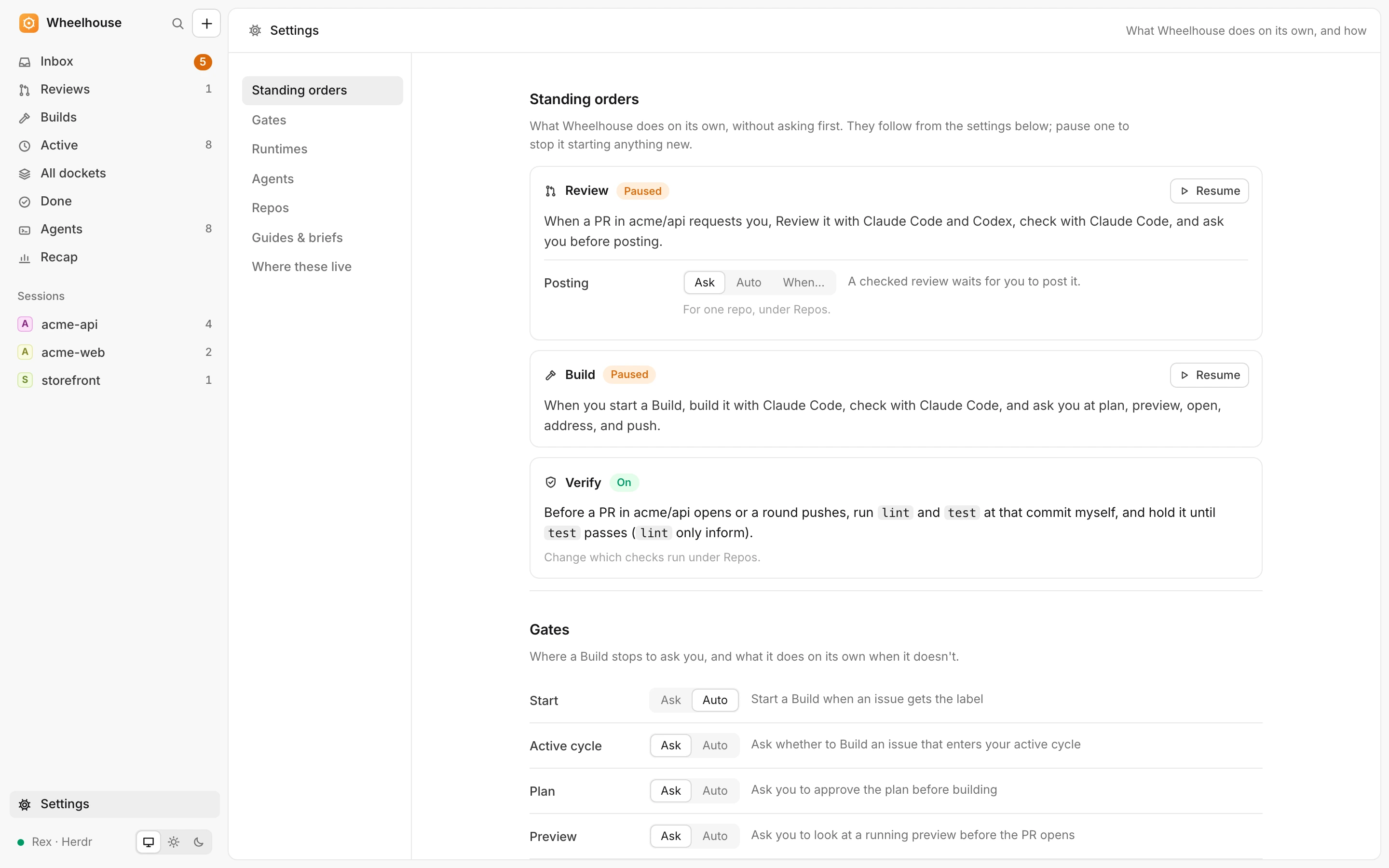
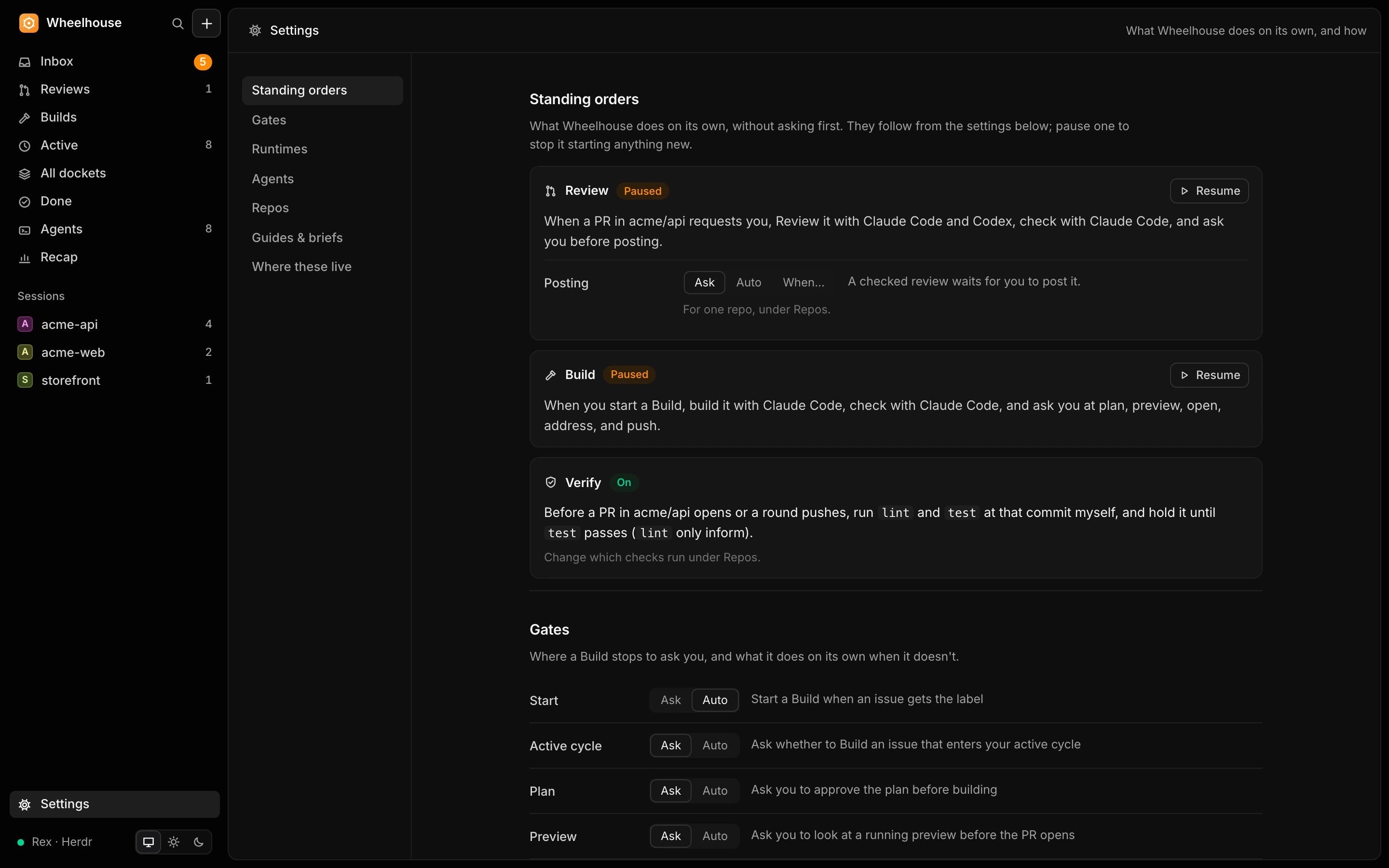
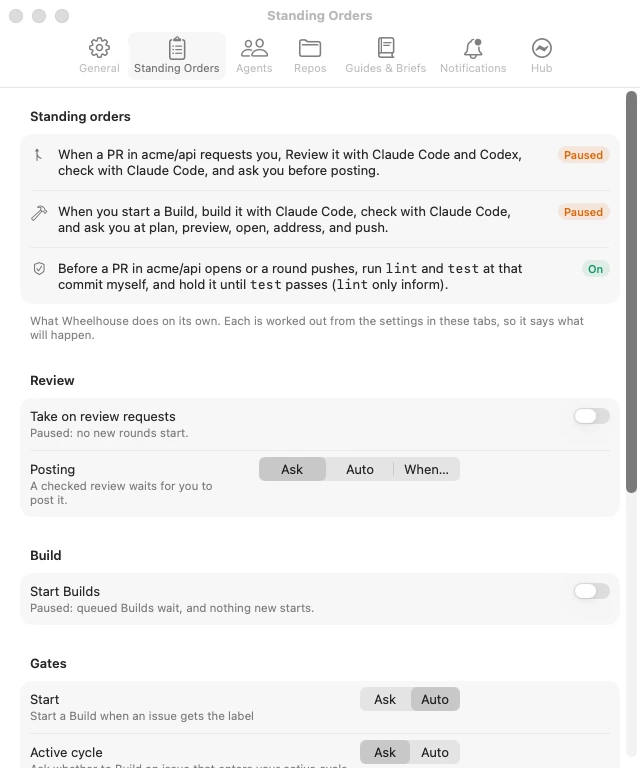
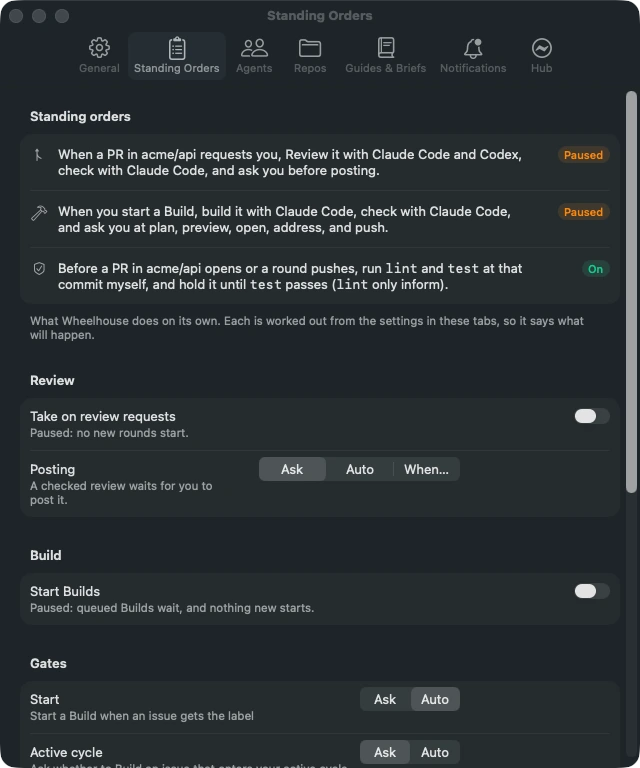
Standing orders
Section titled “Standing orders”The first thing Settings shows is each rule that starts work without you, and how that work runs. For example:
- When a PR in acme/api requests you, Review it with Claude Code and Codex, check with Claude Code, and post it if it approves and its merge risk is low, or else ask you.
- In acme/docs, a checked review posts itself.
- When an ENG issue assigned to you is labeled
agent, build it with Claude Code, check with Codex, and ask you at plan and open. - Before a PR in acme/api opens or a round pushes, run
testandlintat that commit myself, and hold it untiltestpasses.
They’re worked out from the config, so they always say what will happen.
What you can change
Section titled “What you can change”| Section | What’s in it |
|---|---|
| Standing orders | What Wheelhouse does on its own, as sentences: Review’s and Build’s switches, and who posts a checked review for every repo (Ask, Auto, or When… a rule holds) |
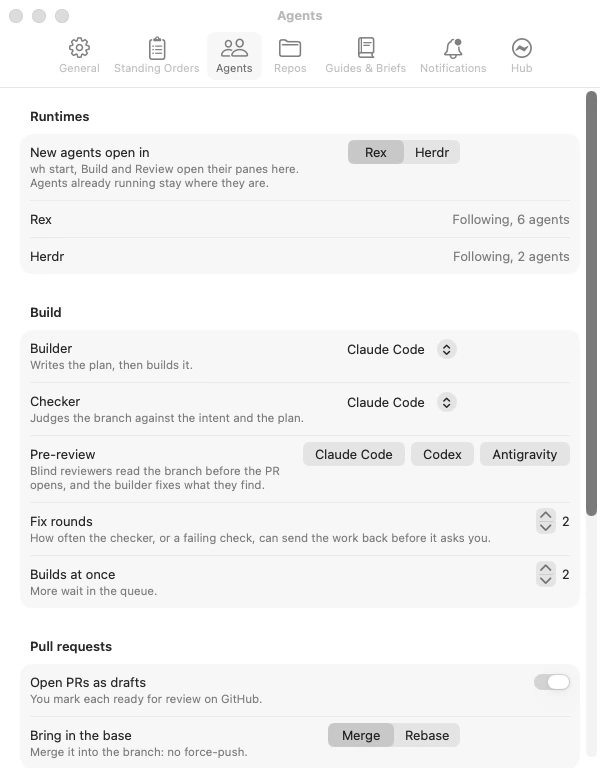
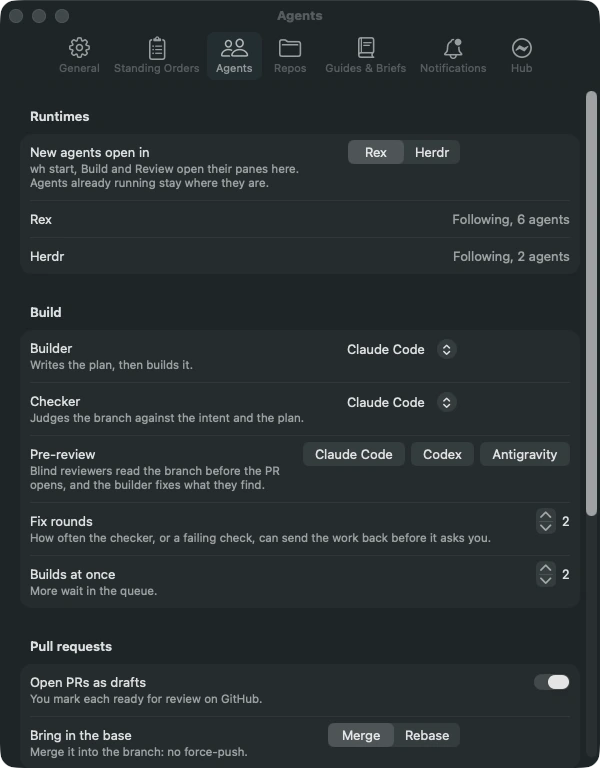
| Runtimes | Where new agents open, Rex or Herdr, and whether each runtime is followed. Agents already running stay where they are. In Wheelhouse.app, it’s under Agents |
| Gates | Each of Build’s gates: ask you, or go ahead |
| Agents | Build’s builder, checker and pre-reviewers, fix rounds, whether PRs open as drafts, and how a round brings in the base (merge, or rebase); Review’s reviewers and checker |
| Repos | Notes for agents (the repo’s rules), the base branch, how much of the plan goes on the PR, witnessed checks, the repo’s review guide, and who posts its reviews when it differs from every repo’s |
| Guides & briefs | The Markdown each agent is given: edit it, compare it with the built-in, reset it, or write a guide of your own |
Build’s gates
Section titled “Build’s gates”Each gate is Ask (it waits for you) or Auto (it goes ahead).
| Gate | When it asks |
|---|---|
start |
A labeled issue would start a Build. Auto by default |
start_cycle |
An issue in your Linear cycle is offered a Build. Ask by default |
plan |
The builder’s plan is ready |
preview |
There’s something to see, shared on your tailnet |
open |
The PR is ready to open, as it will open |
address |
The open PR has review comments, failing checks, or a base that moved |
push |
A round’s commits and replies are ready to push and post |
Every gate but start asks by default. See Build.
A repo’s notes go into every brief in that repo: the builder’s, the
checker’s and the reviewers’. Use them for the repo’s rules: “Run just check
before you commit.”
Its checks are the commands the hub runs itself, at the commit, and records as witnessed. Each is required (a failure holds the PR or the round) or only informs. See Verify.
Standing decisions
Section titled “Standing decisions”A decision you answered on one docket can stand for its repo. Make standing on the decision adds it to the repo’s notes, under “Standing decisions”, with where it was decided:
- How many retries? 3: To match the API docs. (Decided on D-6, November 18.)Every later brief in that repo carries it. Settings → Repos shows and edits it, and the docket keeps an entry saying you made it so.
Guides and briefs
Section titled “Guides and briefs”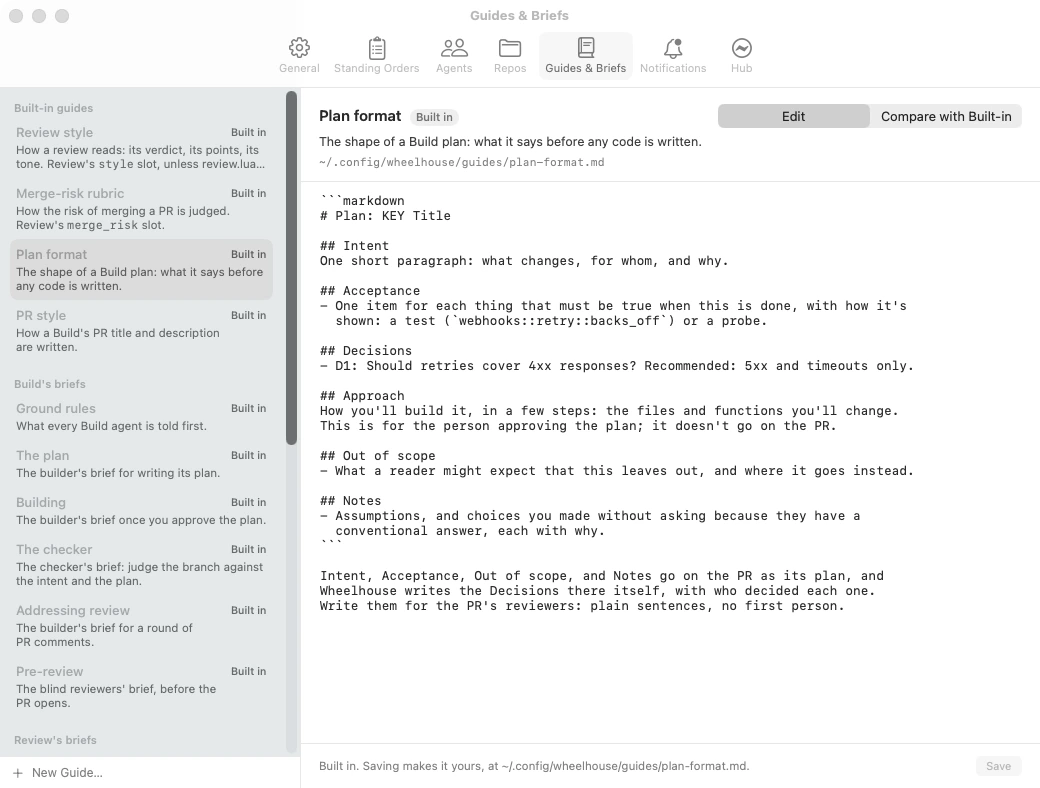
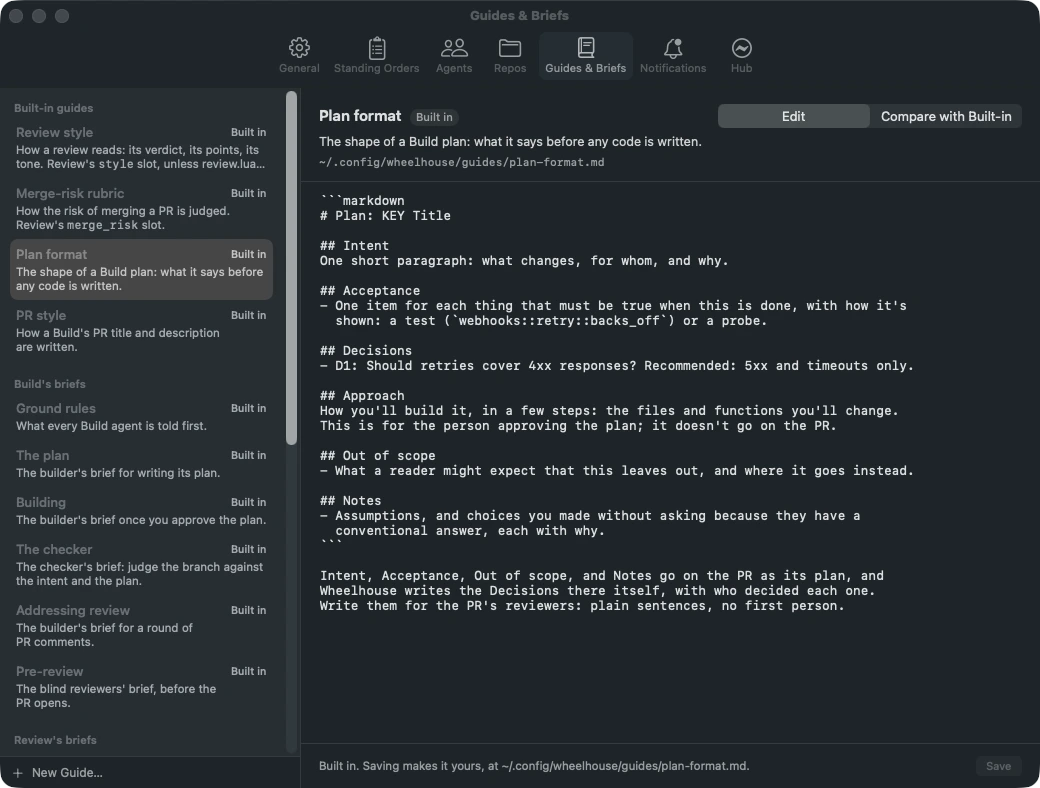
Guides and briefs are what each agent is told. A brief uses {{VARIABLES}}
the hub fills in. A broken one changes what every agent is told, so
Compare with Built-in before you save. Reset sets yours aside and
brings back the built-in one.
Where it’s kept
Section titled “Where it’s kept”What you change in Settings is saved to ~/.config/wheelhouse/settings.json,
shaped like the Lua configs and laid over them as they’re read:
{ "build": { "gates": { "open": "auto" }, "repos": { "acme/api": { "notes": "Run just check before you commit.", "checks": { "test": "cargo test" } } } }, "review": { "repos": { "acme/api": { "guides": { "review": "~/.config/wheelhouse/guides/api-review.md" } } } }}- A value here wins over
build.luaorreview.lua. Use build.lua’s takes it back out, and the file’s value returns. - Review’s posting rule is replaced whole, not key by key. Setting it ends a
wh review post-modeoverride. - A check
build.lualists can be turned off here; Settings writes it asfalse. - Every change is checked by the same code that reads the Lua. One that wouldn’t load is refused with the reason, and nothing is written.
Guides and briefs are files. Yours replace a built-in one of the same name
under ~/.config/wheelhouse/: guides/, briefs/build/ and
briefs/review/. A guide of your own can’t be removed while a config still
names it.
Whatever a save replaces, settings.json or a guide or brief, is kept in
~/.config/wheelhouse/.history/, stamped with the time.
Prices
Section titled “Prices”Recap costs tokens at each model’s API price (see
Recap). Prices for Anthropic’s, OpenAI’s and Google’s
models are built in. prices in settings.json sets a price the hub doesn’t
have, or changes one it does, in US dollars per million tokens. Each model is
keyed by its provider (anthropic, openai, google, openrouter,
ollama…, in any case) and its name as Recap shows it:
{ "prices": { "anthropic": { "Opus 5.5": { "cache_write_1h": 8 } }, "ollama": { "Llama 4": { "input": 0, "cache_read": 0, "cache_write": 0, "output": 0 } } }}| Field | What it prices |
|---|---|
input |
Input not read from the cache |
cache_read |
Input read from the cache |
cache_write |
Input written to the cache (Anthropic’s 5-minute cache) |
cache_write_1h |
Input written to Anthropic’s 1-hour cache. Others: as cache_write |
output |
Output, reasoning included |
- Over a built-in price, a field changes only that field.
- A model with no built-in price needs
input,cache_read,cache_writeandoutput. - Each is a number from 0 to 10,000. A change to
pricesthat isn’t is refused with the reason. - A price written by hand that’s wrong never stops Recap or a change to anything else: it isn’t used, and Recap says why.
The Mac app’s own preferences
Section titled “The Mac app’s own preferences”Wheelhouse.app adds General (appearance, the menu bar icon, ⌥⌘K, open at login), Notifications (and the sound pack) and Hub. See Wheelhouse.app.