Protocols
Recap
What happened today, this week or in the last 30 days, as a standup note, and the tokens all of it took, by provider and model, with what they cost at API prices.
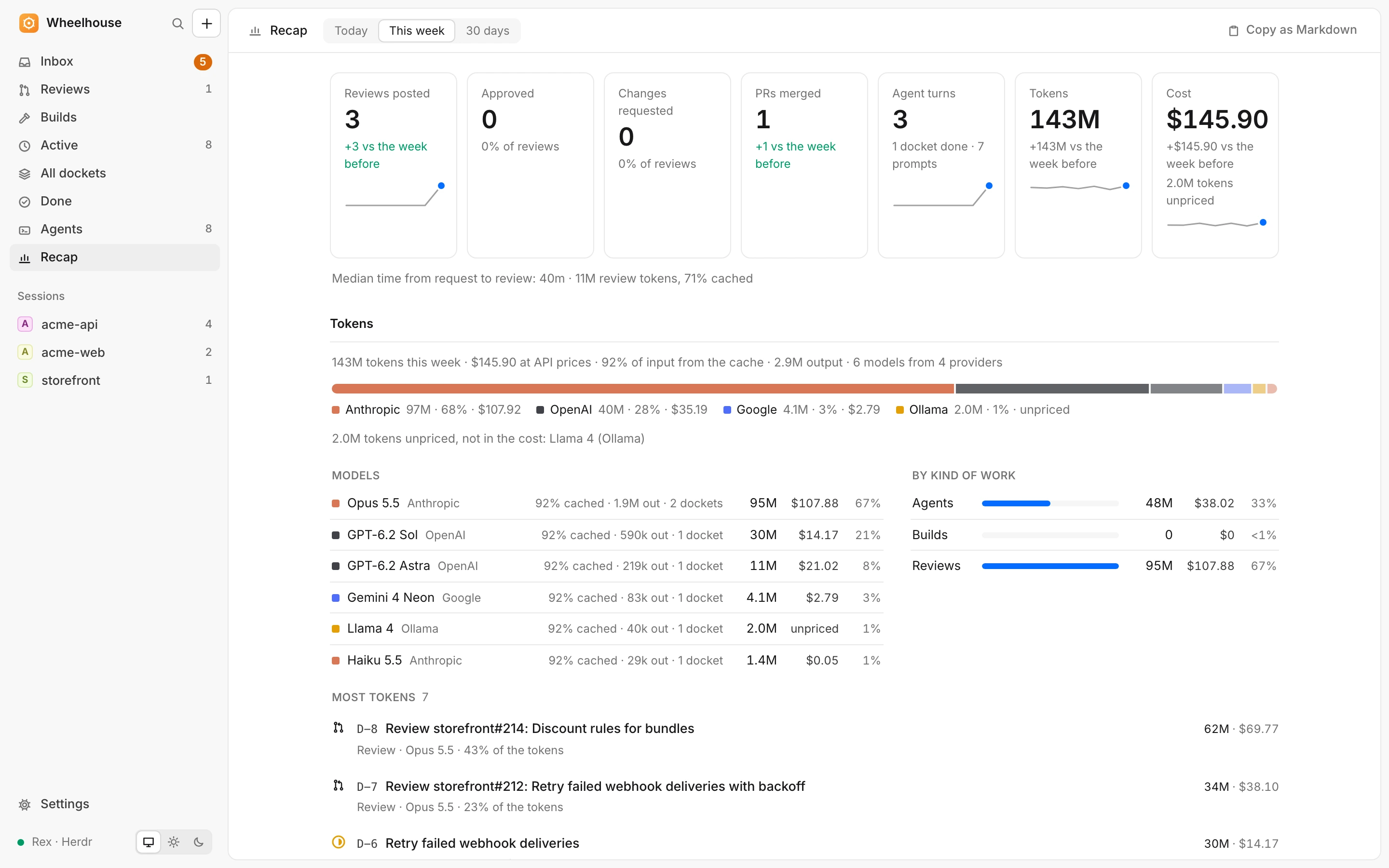
Recap reads the record back to you: what your agents did, what got reviewed and merged, what you decided, and the tokens all of it took and what they cost. Pick Today, This week or 30 days. The headline numbers are set against the period before.
What it shows
Section titled “What it shows”- Reviews. Reviews posted, approved and changes requested, PRs merged, and the median time from request to review. Then the PRs themselves: merged, waiting on their authors, or closed without merging, each with its verdicts across rounds, its merge risk and its author.
- Agents. Dockets started and done, turns, and the prompts you gave, with each finished docket and its last summary.
- Builds. PRs opened, address rounds and the replies they posted, and what merged.
- You. The decisions you made and what you chose, the prompts you approved and denied, the intents you edited, and how often agents asked you.
- Tokens. All of it, across agents, Builds and reviews: by provider and model, per day, by kind of work, and the dockets that took the most. They’re read from the agents’ own transcripts (Claude Code, Codex, Antigravity and Pi), by when each call was made.
- Cost. What those tokens cost at each model’s API price, beside them everywhere: in total and per day, by provider, model, kind of work and docket. See Cost.
As a standup note
Section titled “As a standup note”Copy as Markdown puts the recap on your clipboard, ready to paste into a standup or a weekly note. From a terminal:
wh recap # this weekwh recap todaywh recap 30dIt prints the same Markdown:
## Recap: Nov 10 to 16
**Reviews:** 2 reviews posted (+1 vs the period before) · 1 approved · 1 changes requested · 1 merged · median 20m from request to review
**Merged**- [api#341](https://github.com/acme/api/pull/341) Add rate limiting: ✕ → ✓, 2 rounds, low risk, @dana
**Agents:** 6 dockets started, 4 done, 31 turns, 9 prompts from you- D-47 Flaky retry test: Fixed the flaky retry test. Tests pass.
**You:** 2 decisions, 5 approvals, 0 denied- D-41 Retry failed webhooks: chose “5xx + timeouts”
With tokens in the period, it adds a Tokens: line, and a Cost: line by provider, model and kind of work:
**Cost:** $145.90 at API prices (+$12.40 vs the period before) · Anthropic $107.92 (Opus 5.5 $107.88, Haiku 5.5 $0.05) · OpenAI $35.19 (GPT-6.2 Sol $14.17, GPT-6.2 Astra $21.02) · Google $2.79 · agents $38.02, reviews $107.88 · 2M tokens unpriced: Llama 4 (Ollama)Each model’s tokens are costed at its API price, per million tokens: input, input read from the cache, input written to it, and output. Prices for Anthropic’s, OpenAI’s and Google’s models are built in, from each provider’s own pricing page, and change on the day a provider says they do.
- Cache writes by the cache they went to. Claude Code’s transcripts say whether a write went to Anthropic’s 5-minute cache (1.25× input) or its 1-hour one (2× input), and each is costed at its own price. Claude Code writes almost everything to the 1-hour cache. Other tools’ writes are at their provider’s default.
- Never a guess. A model the hub has no price for, such as a local one or
one through a reseller (OpenRouter, Pi’s
openai-codex), is shown as unpriced with its tokens. It’s never counted as $0, and when nothing is priced Recap says so. - Your own prices. Set or change any model’s price under
pricesinsettings.json, one field or all of them. See Settings. - API prices, not your bill. On a subscription, it’s what the same work would cost through the API. It doesn’t count fast mode, US-only inference, the dearer prices for very long prompts, or Gemini’s cache storage.
Limits
Section titled “Limits”Tokens come from the agents’ own transcripts. The tools prune those (Claude Code’s go after 30 days), so the hub keeps them: about once a day it snapshots each transcript’s calls, a minute and a model at a time, into its own store. Recap counts from what it kept, with anything written since read over it, so a month-old week still adds up after its transcripts are gone. A transcript that moved counts once. The first snapshot takes everything on disk, so tokens reach back to the oldest transcript you had when the hub first ran.
Minutes the hub kept before it knew which cache a write went to are read again once, after an update; those whose transcripts are already gone are costed as 5-minute writes, a little under what they cost.